Mixed-case order fulfillment is what happens when "the order could be anything." One order contains 3 units of SKU A, 1 unit of SKU B, and 7 units of SKU C. The next order has a different combination entirely. Across a thousand orders in a shift, no two order profiles are identical. The items aren't pre-packed together. They live in separate bin locations across the pick floor, and each one has to be found, picked, and consolidated into a single outbound shipment.
For a 3PL running multiple client accounts in a shared facility, mixed-case fulfillment is complicated further by the fact that the SKU catalog changes regularly, the order profiles are set by the client's customers rather than the 3PL, and SLAs are per-client rather than per-order. Most WMS platforms were designed with single-tenant operations in mind. Their wave planning logic optimizes for pick path efficiency within a homogeneous order pool. Mixed-case multi-tenant fulfillment breaks that assumption at every layer.
Why Wave Planning Fails in Mixed-Case Multi-Client Environments
Standard wave planning logic works like this: open orders are aggregated, pick tasks are generated, tasks are sorted by location to minimize travel, and waves are released to the pick floor. This produces efficient pick paths when order profiles are consistent and the pick pool belongs to one client.
Mixed-case multi-client environments break this logic in three places:
Order profile variance invalidates path optimization. When order 1 requires picks from zones A, C, and F, and order 2 requires picks from zones B, D, and G, and orders 3 through 100 have equally heterogeneous profiles, the combined pick path is no longer a clean sweep of adjacent locations. It's a scatter pattern. Traditional travel-distance optimization doesn't produce meaningful gains when orders are pulling from diverse locations — it produces a long pick list in a mildly more efficient order.
Client segregation constraints conflict with path optimization. If Client A's SKUs are in one section of the pick floor and Client B's SKUs are in another, a wave that mixes both clients' orders for path efficiency will produce a confirmation tracking problem. When picker confirms a pick, which client account does it bill against? If the WMS doesn't carry client attribution through every pick task, reconciliation becomes a manual process.
SLA urgency varies across clients in the same wave window. Client A has a 2 PM shipping cutoff. Client B has a 4 PM cutoff. A combined wave that doesn't prioritize Client A's orders will produce on-time shipping for Client B at the cost of a chargeback from Client A. Standard wave planning treats all orders in a wave as equivalent urgency — which is only true in a single-client environment where the shipping cutoff applies uniformly.
The Wave Architecture That Works: Order Profile Clustering
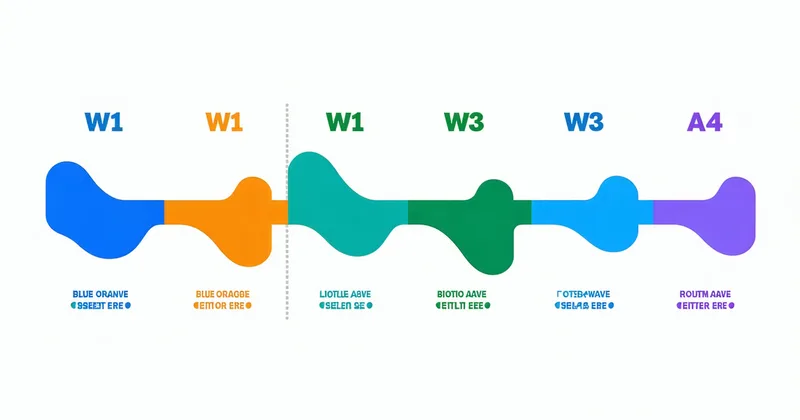
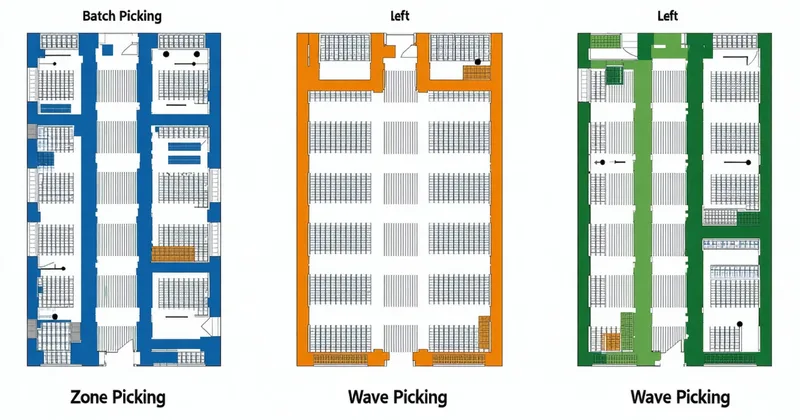
The wave structure that handles mixed-case multi-client fulfillment effectively starts with order profile clustering at wave generation — not after. Before the WMS generates pick tasks, the wave planner groups orders by pick location density: orders that pull from overlapping zones are clustered into the same wave, and orders with disparate location profiles are assigned to separate waves or separate wave slices.
In Manhattan Active WMS, this can be implemented through pick region assignment rules combined with order grouping logic in the wave template. The WMS evaluates each open order's pick region coverage and groups orders with sufficient regional overlap into the same wave batch. Orders with high location scatter — spanning more than 60–70% of the pick floor's distinct zones — are either held for the next wave window or assigned to a dedicated scatter wave processed by human pickers rather than the robot cell.
Blue Yonder Luminate supports similar clustering through its order wave management rules, with configurable density scoring that can be tuned to match the facility's specific pick zone layout. SAP EWM's warehouse order creation rules can model the same logic but require more configuration effort and typically involve a custom rule set rather than native configuration parameters.
Where the Autonomous Pick Cell Fits in Mixed-Case Fulfillment
In a mixed-case environment, the robot cell's scope needs to be defined more carefully than in a single-SKU-type environment. The robot is most effective on the portion of each order that consists of A/B class SKUs with high pickability scores — items that appear across many different order profiles and can be pre-picked into individual order totes before the rest of the order's items are picked by humans.
This is a cluster picking variant: the robot pre-picks the robot-eligible items for multiple orders simultaneously, staging completed order totes at the consolidation point. Human pickers complete each order by adding the remaining items — C-class, irregular, or below-pickability-threshold SKUs — from the human pick zones. The order is consolidated and packed when both the robot and human contributions have been merged.
In a mid-size Midwest fulfillment operator running a mixed-case consumer goods program with 7 client accounts in 2025, this architecture reduced average order cycle time by 22% for orders where more than 50% of the item count fell within the robot cell's eligible SKU scope. For orders where less than 30% of items were robot-eligible, the cycle time benefit was minimal — those orders were processed primarily in human pick zones with only a small fraction of items pre-picked by the robot. The system correctly identified these order profiles and routed them accordingly at the wave generation stage.
Handling Variable-Quantity Picks
Mixed-case fulfillment frequently includes variable-quantity pick events: an order calls for 3 units of a SKU, and those 3 units need to be picked from a single bin location as a multi-unit pick. For human pickers, multi-unit picks are natural — pick three, count, confirm. For the robot cell, multi-unit picks from a single bin require multiple pick cycles (one item per pick event) unless the bin contains a pre-packaged multi-unit configuration.
The practical implication: for robot-eligible SKUs where orders frequently call for quantities greater than 1, the robot cell's effective throughput on those SKUs is lower than its single-unit pick rate would suggest. An order calling for 4 units of a SKU requires 4 pick events at the robot cell — 4 cycles of vision, grasp, place, confirm. This is still faster than a human pick on the same quantity in most A/B class scenarios, but the throughput calculation for mixed-case waves needs to account for multi-unit pick frequency.
Pickrook's wave planning integration surfaces this through a picks-per-order metric at wave generation: the estimated robot cycle time for a wave is based on the total pick events assigned to the robot (units, not SKUs), not the order count. This prevents throughput overestimation on waves that are order-count-light but unit-count-heavy.
Pack Station Integration
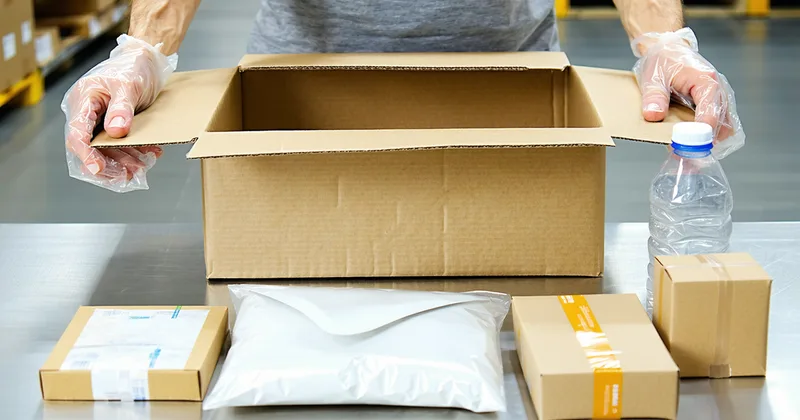
Mixed-case fulfillment ends at the pack station, where individual picked items are verified and packed into outbound shipments. In a robot-assisted operation, the pack station receives pre-picked robot totes (containing the robot-eligible portion of multiple orders) and human-picked additions. The pack station operator needs to know, for each outbound order, which items came from the robot cell and which came from human pick zones — both for verification purposes and for order completion timing.
We're not saying complex pack station integration is required for a functional pick cell — we're saying that the order completion visibility at the pack station is a real operational consideration that needs to be mapped before go-live. If the pack station operator can't see which items have been pre-picked by the robot for a given order, they may begin packing incomplete orders or duplicate picks that the robot already completed. A simple pick completion flag on the WMS order screen — showing which items have robot pick confirmations and which items are still pending human picks — addresses this cleanly without requiring a custom pack station display system.
Mixed-case order fulfillment in a multi-tenant 3PL is genuinely the hardest picking problem to automate partially. The wave planning architecture, client segregation, variable-quantity handling, and pack station visibility all have to work together for the robot cell to produce its expected throughput contribution. If you're running mixed-case fulfillment and want to map out the specific architecture for your WMS and facility layout, start a pilot conversation.