The standard automation ROI model was designed for captive fulfillment centers with predictable SKU mixes, stable labor rates, and capital budgets that amortize equipment over seven to ten years. 3PL piece-picking doesn't look like any of those things. Client accounts turn over. Order profiles shift quarterly. Labor costs include not just hourly wages but agency markup, overtime premiums, and benefits that vary with headcount levels. Building an honest business case for an autonomous pick cell at a 3PL requires a different model — one that accounts for how 3PL economics actually work.
This article walks through the cost structure we use when helping operators build an internal business case for a Pickrook pilot, including where the conventional automation ROI model overstates the benefit and where it understates it.
The Cost-Per-Pick Baseline: What You're Actually Paying Now
The first number you need is your true labor cost per pick — not just base wage, but total labor burden for the pick function. For most mid-size 3PL operators, this includes:
- Base wage: typically
$17–$22/hrfor warehouse pick roles in major US metro areas as of 2025, higher in coastal markets and during peak-season contract periods - Agency markup: if you staff 40–60% of your pick team via temp agencies (common practice), add 30–45% to the agency-placed labor cost
- Benefits burden: for direct employees, add 20–28% for health insurance, payroll taxes, PTO accrual
- Supervision: pick floor supervisors and team leads don't pick, but they're a direct cost of the pick function — typically 1 supervisor per 15–20 pickers
- Training and turnover: annual picker turnover in 3PL environments commonly runs 60–90%. Each hire requires 2–4 days of onboarding before a new picker reaches baseline productivity
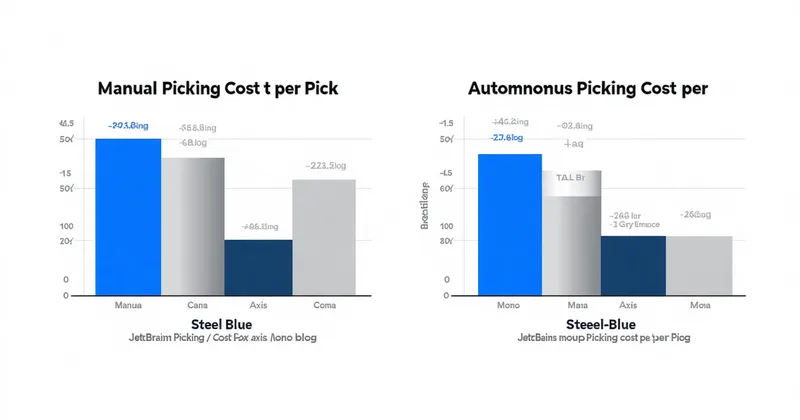
When you stack these costs, the true labor cost per pick for a typical 3PL shifts range runs $0.55–$0.90 per pick at full burden. If you're using an internal figure of $0.35–$0.40 per pick based only on base wage, your baseline is understated and your ROI calculation will look worse than it actually is when you compare against autonomous picking cost.
The Pick Cell Cost Structure
Autonomous pick cell costs fall into three categories: deployment, software subscription, and maintenance. For a Pickrook pick cell deployment in a mid-size 3PL facility, the economics look approximately like this:
- Deployment: one-time cost covering site survey, hardware installation, WMS integration setup, and operator training. This amortizes over the contract term.
- Annual software and support subscription: covers ongoing WMS integration maintenance, vision model updates, remote monitoring, and on-site support response. Priced per cell per year; scales with throughput volume for high-pick-rate accounts.
- Consumables: gripper tips, suction cups, and similar wear items. Typically budgeted at
$200–$400/monthper cell in continuous operation environments.
The total cost per pick for an autonomous cell operating at sustained 280 picks/hr across two 8-hour shifts works out to $0.12–$0.22 per pick depending on labor market assumptions for the monitoring role and the specific contract structure. That's a 60–75% reduction vs. fully burdened human labor cost at the high end of the labor rate range above.
Where 3PL-Specific Variables Change the Model
Client Volatility and Volume Commitment
The biggest risk factor in a 3PL automation ROI model is client churn. If a client account that drove 40% of your pick volume ends its contract, your pick cell is suddenly operating well below its optimal throughput — and your cost-per-pick climbs because the fixed cost is being spread over fewer picks. A conventional greenfield fulfillment center doesn't have this problem; its order volume is a function of its own retail or wholesale business.
The right way to model this is to run the ROI calculation at three volume scenarios: current contracted volume, a 25% volume reduction (simulating partial client churn), and a 25% volume growth (simulating new client acquisition during the contract period). The business case should survive the 25% reduction scenario. If the pick cell only makes financial sense at current volume or above, the risk-adjusted ROI may not justify the commitment for a mid-size operator without a locked multi-year client contract.
Peak Season Labor Premium
3PLs that serve e-commerce, retail, or consumer goods clients face dramatic labor cost spikes during Q4. Overtime rates, temp agency surge pricing, and retention bonuses all elevate per-pick labor costs by 30–50% during a 6–10 week peak window. A pick cell's cost doesn't change during peak. It runs the same cost per pick in October as it does in March.
This seasonal differential is one of the most undervalued components in the ROI calculation. If your facility processes 2.5× normal volume during peak, and peak labor costs are 35% higher than base period labor costs, the pick cell's per-pick cost advantage is amplified significantly during exactly the period when throughput pressure is highest. Model peak season separately, not as a simple annual average.
Pick Accuracy and Rework Cost
Pick accuracy errors have a cost that doesn't appear in most labor-cost-per-pick calculations: rework. When a mis-pick reaches a customer or retail distribution center, the direct cost includes return shipping, re-pack labor, and in some cases chargeback penalties from retail clients. Industry benchmarks for human piece-picking accuracy typically fall in the 98.5–99.5% range; high-throughput human pick operations under pressure commonly fall below 98.5%. Autonomous pick cells operating with validated vision systems consistently produce 99.2–99.6% accuracy in production conditions.
In a 3PL operation processing 50,000 picks per shift, a 0.8 percentage point accuracy improvement prevents approximately 400 pick errors per shift. If each mis-pick error costs an average of $8–$15 in rework, return logistics, and client relationship cost, the accuracy benefit alone adds $3,200–$6,000/shift to the ROI calculation. Most business cases for automation in 3PL environments don't include this line item at all.
The Multi-Shift Throughput Multiplier
A pick cell doesn't call in sick, doesn't take breaks that run 12 minutes instead of 10, and doesn't have a productivity dip in hour seven of an eight-hour shift. Over a two-shift operating day, the throughput consistency advantage compounds in ways that are difficult to model precisely but easy to observe operationally. We're not saying human pickers don't work hard — we're saying that human throughput variability across a shift is real and measurable, and a robot cell's throughput variability is primarily driven by SKU characteristics and pick queue composition, not human factors.
For the business case, use a human pick rate that reflects observed actual throughput — including break time, productivity variation, and end-of-shift fatigue effects — rather than theoretical peak capacity. If your best human picker hits 90 PPH under ideal conditions but your average across a shift is 72 PPH including all the realities of a live pick floor, use 72 in the calculation. The robot cell's effective PPH should similarly be based on observed performance in a comparable deployment, not the hardware maximum.
Building the Case for a Pilot vs. Full Deployment
The pilot business case is different from the full deployment business case. A pilot pick cell is a single-cell deployment in a contained zone, designed to validate throughput, accuracy, and integration against your specific SKU profile and WMS configuration. The pilot ROI calculation should cover: cost of pilot deployment, expected throughput benefit during the pilot period, data collected for a full deployment decision, and the risk-adjusted value of knowing before committing to a full facility build-out.
One outcome no ROI model accounts for adequately is the operational learning you accumulate during a pilot. The slotting adjustments, exception routing refinements, and WMS configuration changes that happen during a pilot deployment are worth real money when applied to a full deployment. Operations teams that go straight from proposal to full deployment without a pilot frequently spend 3–6 months in a post-go-live tuning phase that a pilot would have compressed into 4 weeks.
If you're building an internal business case for a pick cell and want to pressure-test the numbers against your facility's actual pick data, start a pilot conversation. We'll run the cost-per-pick analysis with your actual order history before asking for any commitment.