When we designed the vision-gripper stack for Pickrook, we made a deliberate decision early on: build the pickability scoring system before building the gripper selection system. The reason is straightforward — every gripper technology has a defined envelope of items it handles well and a boundary beyond which performance degrades sharply. Knowing where that boundary is, and routing items outside it away from the robot before they reach the cell, is more valuable than trying to design a gripper that handles everything.
This article is about that boundary. We're going to describe exactly what vision-guided grippers handle confidently, where performance degrades, and what categories of items we route to human exception stations by default. We'd rather tell you this directly than have you discover it after go-live.
What Vision-Guided Pick Systems Do Well
The core capability of a vision-guided manipulation system is reliable identification and grasp planning for items with predictable physical characteristics. In a 3PL forward pick environment, that means items with:
- Defined rigid geometry: corrugated boxes, rigid plastic containers, canned goods, boxed electronics, and other items that maintain consistent shape regardless of how they're stored or how many adjacent items have been removed from the bin.
- Consistent surface texture: matte or semi-gloss packaging with printed graphics provides good feature points for the vision system's pose estimation. Items with high contrast packaging patterns are reliable; items with uniform glossy or matte single-color surfaces require more processing time but remain reliable at acceptable cycle times.
- Weight between 50g and 5kg: this range covers the majority of each-pick SKUs in typical e-commerce and general merchandise 3PL environments. The lower bound is driven by the suction gripper's ability to maintain secure contact; the upper bound is driven by the 6-DoF arm's payload capacity at extended reach positions.
- Size range 80mm to 400mm in longest dimension: items below 80mm are challenging for the vision system to localize accurately in a bin with multiple adjacent items; items above 400mm in their longest dimension may exceed the arm's practical reach envelope at some bin positions.
In validated deployments with SKU catalogs filtered to these characteristics, pick success rates (picks completed without retry or exception routing) run in the 94–97% range on A/B class SKUs. That's the number to use for capacity planning when the upstream SKU profiling has been done correctly.
The Five Categories That Challenge Current Systems
1. Soft Flexible Pouches and Bags
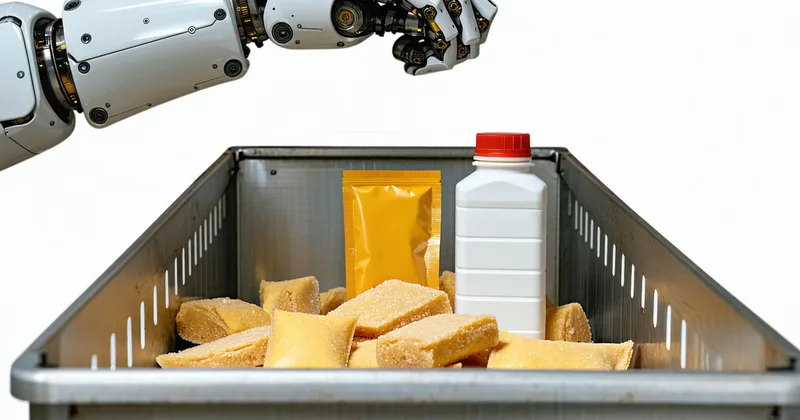
Flexible packaging — stand-up pouches, soft-sided bags, foil or mylar pouches — deforms under suction gripper contact and doesn't maintain a consistent surface normal for the gripper's pose estimation. The vision system can identify the item correctly, but the grasp plan fails because the predicted contact surface isn't where the gripper expects it to be after the item shifts under partial suction.
Parallel-jaw and soft gripper end-effectors handle flexible packaging better than suction-cup systems, but they introduce a different constraint: they require more lateral clearance in the bin to close around the item, which means bin fill density has to be lower — typically 50–60% fill versus 70–80% for suction-compatible items. In a high-density forward pick area, that trade-off isn't always acceptable.
Our current recommendation: flexible pouches and bags above 200g and with dimensions suitable for parallel-jaw approach can be included in the robot cell's scope with a custom gripper configuration. Lightweight flexible items under 100g — individual snack pouches, single-serve packets, small mylar bags — should default to human pick zones unless the SKU volume justifies a dedicated gripper configuration.
2. Highly Reflective or Transparent Packaging
The vision system's depth estimation relies on structured light and stereo imagery. Highly reflective surfaces — mirror-finished metal cans, highly glossy shrink-wrapped items, some cosmetic packaging — produce specular reflections that saturate the depth sensor and create false surface readings. Transparent packaging (clear PET bottles, clamshells, clear bags) presents the opposite problem: the depth sensor reads through the packaging to the item inside or to the bin wall behind it, producing incorrect surface position estimates.
Highly reflective items can often be accommodated by adjusting camera polarization and exposure settings, but the tuning is SKU-specific and adds calibration time per item type. In a 3PL with high SKU turnover — clients adding dozens of new products per month — per-SKU vision calibration isn't scalable. Reflective and transparent SKUs should be routed to human exception stations unless they are high-velocity enough to justify individual calibration effort.
3. Items Below 10 Grams
Very lightweight items — small hardware components, single-use accessories, lightweight pharmaceutical sachets — create two problems: the suction gripper's minimum holding force exceeds the item's weight by a large margin, which can cause the item to be dragged rather than lifted cleanly; and the vision system's localization uncertainty at the millimeter scale becomes a significant fraction of the item's total size. A 5mm localization error on a 150mm box is inconsequential. The same error on a 12mm component is a pick failure.
We're not saying light items can never be automated — we're saying that items below 10 grams require either a dedicated fine-manipulation end-effector (which is outside Pickrook's current hardware configuration) or an ASRS/mini-load feeder system that presents individual items in a precisely controlled orientation. For a standard open-shelf pick cell in a 3PL environment, items under 10g should be in human pick zones.
4. Bundled Multi-Unit SKUs
Bundled items — a six-pack of canned goods held together with a plastic ring, a multi-pack of snack items in a shared bag, two items shrink-wrapped together as a promotional bundle — present a pose estimation challenge because the bundle's center of mass may not be where the vision system predicts based on the outer packaging dimensions. Lifting a bundle by the top surface sometimes shifts the bundle into an unstable orientation mid-pick.
Bundles with rigid outer packaging (cardboard sleeve over multiple items, rigid box containing multiple units) work fine in the robot cell. Bundles with flexible outer packaging or no outer packaging beyond a clip or ring are high exception-rate items that should default to human picking.
5. Items with High Orientation Variance in Bin
When a bin contains items that shift position significantly as picks are made — because the items are round, cylindrical, or have sloped surfaces — the vision system must re-localize each pick rather than using a learned static position. Round cans that roll after each pick, spherical items, cylindrical containers without flat contact surfaces — all generate higher vision processing cycle times and more gripper approach retries per pick event. Peak success rates for high-orientation-variance items are typically 15–20 percentage points below the rates for consistent-geometry items.
How the Exception Routing Works in Practice
Pickrook's pickability scoring system evaluates each SKU on the five axes above and assigns a composite score from 0–100. SKUs scoring below 65 are excluded from the robot cell's wave queue at the WMS integration layer — they appear in the human pick queue, not in the robot's assigned items. SKUs scoring 65–79 are assigned to the robot cell but flagged as higher-exception-rate items; their exception rates are tracked separately and used to inform the monthly slotting review. SKUs scoring 80+ are prime robot-cell items.
When the vision system makes a no-confidence decision mid-pick — the item is present but grasp confidence is below the threshold — the item is placed in the exception tote and routed to the human exception station with the order line ID preserved. Human pickers at the exception station complete those picks at their normal rate. The exception rate is logged per SKU and per pick event, and reported in the daily operations dashboard.
This architecture means the robot cell's reported PPH is based on completed picks, not attempted picks. The exception tote throughput is tracked as a parallel human pick metric, not blended into the robot's performance number. That separation is how you get a meaningful throughput benchmark — and it's why we're transparent about the pickability envelope rather than inflating the robot's claimed capability scope.
If you want to run your facility's SKU catalog against Pickrook's pickability scoring framework before a pilot conversation, reach out here. We'll score your top-200 SKUs by velocity and tell you exactly what percentage falls in each tier — including the items that will need to stay in human pick zones.