OSHA's general machine guarding standard — 29 CFR 1910.212 — sets the baseline requirement: machines must be guarded to protect operators from the point of operation, ingoing nip points, rotating parts, flying chips and sparks. For a robotic pick cell in a 3PL warehouse, that standard is the floor, not the ceiling. The practical safety design decisions for a pick cell in a live fulfillment environment involve considerably more nuance than the regulatory baseline captures — and most of it isn't covered in any standard.
This article covers both: what the relevant standards actually require, and the practical safety decisions that come up in every pick cell deployment that no standard addresses directly.
The Applicable Standards Stack
For a robotic pick cell operating in a warehouse where human workers are present, the applicable standards are:
- OSHA 29 CFR 1910.212: General machine guarding. Applies to all machinery in a US workplace. The relevant requirement is that the guarding method must prevent operator contact with the hazard zone. For a robot cell, this means the work envelope must be either physically guarded (hard barriers) or guarded by a presence-sensing system that stops motion when a person enters the protected zone.
- ANSI/RIA R15.06 (Industrial Robots and Robot Systems — Safety Requirements): The US industrial robot safety standard, developed by the Robotic Industries Association. Covers robot cell design, safeguarding methods, and risk assessment procedures. R15.06 requires a formal risk assessment for every robot installation, documented to show that each identified hazard has been reduced to an acceptable risk level.
- ANSI/RIA R15.08 (Industrial Mobile Robots — Safety Requirements): Applies if the pick cell includes mobile robot elements (AMRs for bin delivery or tote routing). R15.08 addresses the specific hazards of autonomous vehicles sharing space with pedestrians — zone detection, speed and separation monitoring, emergency stop response.
- ISO/TS 15066 (Robots and Robotic Devices — Collaborative Robots): If the pick cell uses a collaborative robot configuration where the robot and human pickers work in adjacent or shared zones without full physical separation, ISO/TS 15066 provides the framework for power and force limiting, speed and separation monitoring, and hand-guiding modes. This standard is relevant for exception handling stations where a human picker works near the robot's operating zone.
We're not saying every operator needs to implement ISO/TS 15066 for every pick cell configuration — we're saying that if your pick cell layout puts human exception handlers within 6 feet of the robot's operating envelope, you're in collaborative robot territory and the design criteria in ISO/TS 15066 become directly relevant to your risk assessment.
Practical Safety Decisions That Standards Don't Fully Answer
Light Curtains vs. Area Scanners: The Right Choice for a Live Pick Zone
Hard barriers — physical fencing around the robot cell — are the simplest safeguarding approach and the one most easily validated for an OSHA inspection. But in a 3PL pick zone where human pickers work 10–20 feet from the robot cell and need access to adjacent pick aisles, hard barriers create operational friction. Replenishment workers need access to the robot cell's pick face for bin refills. Supervisors need visual access to the cell. Hard barriers make these interactions slower and create bottlenecks.
The practical alternative is a combination of light curtains (for the primary access points to the robot's work envelope) and area scanners (for the broader zone surrounding the cell). Light curtains are appropriate at defined entry points where personnel would cross into the robot's immediate work zone — they stop robot motion immediately on beam break and require a manual restart after the person exits. Area scanners establish a configurable safety zone around the cell perimeter, reducing robot speed when a person enters the warning zone and stopping motion when they enter the closer protected zone.
In a Pickrook deployment at a mid-Atlantic regional 3PL facility in 2025, the pick cell used area scanners (SICK microScan3 Pro) defining a 2.0m warning zone and a 0.6m protected zone, with light curtains at the two replenishment access points. The configuration allows replenishment workers to approach the cell for bin refills in the warning zone (robot slows to 30% speed) and requires the robot to stop and wait when they cross into the protected zone. The result was a natural workflow where replenishment could happen during operation without requiring a full cell shutdown — reducing the throughput cost of replenishment events by approximately 35% compared to a hard-barrier configuration that required a manual restart after each replenishment event.
E-Stop Placement and Restart Procedures
ANSI/RIA R15.06 requires that emergency stop devices be readily accessible and clearly identifiable. The practical implementation question is: how many e-stops do you need, and where? The standard's answer — "readily accessible" — doesn't specify count or placement geometry in a way that resolves real deployment decisions.
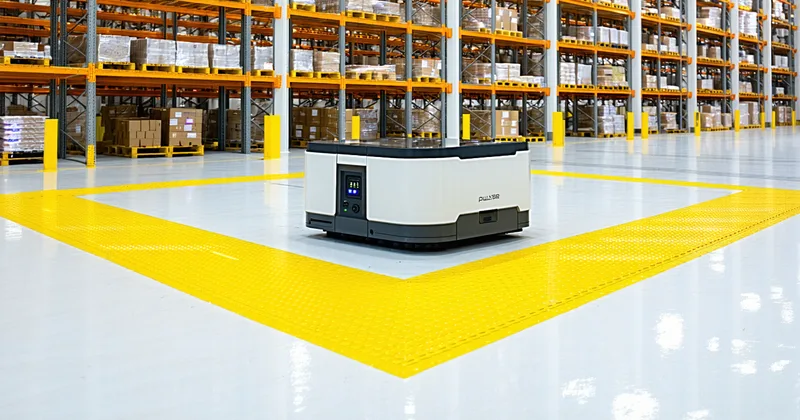
Our field practice is to install e-stops at a minimum of four positions around the cell perimeter: one at each primary pedestrian access point, and at least one within visual range of any adjacent human pick station that has a direct line of sight to the robot work envelope. E-stop positions are marked on the floor with high-visibility safety tape and included in the operator training curriculum. Restart procedures require a deliberate operator action — not an automatic restart after safeguard reset — to ensure a person can't inadvertently re-energize the cell without confirmation that the cell is clear.
The Client SKU Turnover Safety Problem
Here's the safety consideration that doesn't appear in any standard: 3PL client SKU mix changes. A client adds 50 new seasonal products for Q4. Some of those products have packaging characteristics that weren't in the robot cell's vision training set and pickability evaluation. A new SKU with unexpectedly rigid, heavy packaging arrives in a bin designated for lightweight items. The robot attempts a pick, the item is heavier than the system expected, and the gripper applies the wrong force profile.
This is not a dramatic safety hazard — Pickrook's force limits are set conservatively and the worst-case outcome is a dropped item or a mishandled pick, not an injury event. But it illustrates a procedural gap that has to be filled operationally: there needs to be a formal process for evaluating new SKUs for pickability and safety flags before they're assigned to the robot cell's pick face. In a 3PL with multiple client accounts adding new products throughout the year, this evaluation process needs to be built into the client onboarding workflow, not treated as a one-time pre-deployment activity.
The Risk Assessment Document
ANSI/RIA R15.06 requires a documented risk assessment for each robot installation. For an OSHA inspection, the risk assessment document demonstrates that the installation was designed with a systematic evaluation of hazards rather than improvised safeguarding. The document needs to cover: identified hazards (robot motion, payload drops, pinch points at the end-of-arm tooling, interaction with adjacent pedestrian traffic), risk evaluation for each hazard (severity × probability), safeguarding measures applied to reduce each risk, and residual risk level after safeguarding.
Pickrook generates the risk assessment document as part of the deployment process. Operators receive a copy as part of their deployment package. We recommend having the document reviewed by the facility's safety officer or EHS team before go-live — not because we expect deficiencies, but because the safety officer's familiarity with the document is useful when a new employee or a client visitor asks questions about the robot cell during a floor tour. A safety officer who can point to the risk assessment and explain the light curtain configuration is a more effective safety communicator than one who has to say "I'll ask the robotics company."
Operator Training Requirements
R15.06 requires that personnel who work with or near robots receive task-specific safety training. For a 3PL pick cell deployment, this covers three groups: (1) direct robot cell operators and technicians — anyone responsible for the cell's operation, maintenance, or troubleshooting; (2) adjacent workers — human pickers who work in the same aisle or adjacent aisles and need to understand the safety zone boundaries and e-stop locations; and (3) supervisors — floor supervisors who need to know how to initiate an e-stop and manage the restart procedure.
The training requirement applies to new employees who are assigned to areas adjacent to the pick cell after go-live — which in a 3PL with high turnover means the training curriculum needs to be a recurring item in new-hire orientation, not a one-time go-live event. We deliver training materials in both English and Spanish for deployments in facilities with bilingual workforces — the language of the safety instruction matters as much as its content.
If you're planning a pick cell deployment and want to understand the specific safety configuration and risk assessment process for your facility layout, start a pilot conversation. Marcus's team conducts a safety-focused site assessment as the first step of every deployment engagement.